
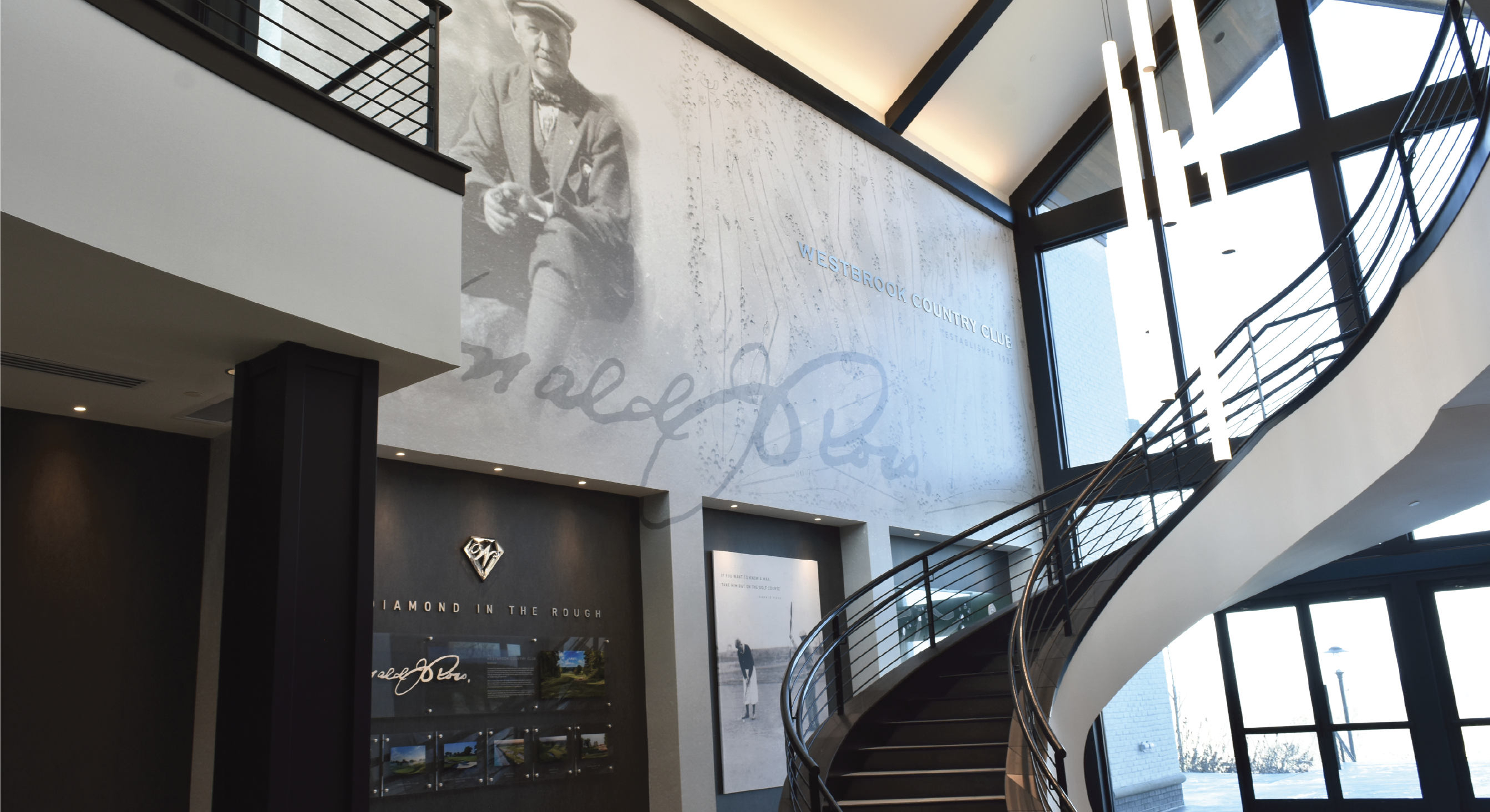
I am often asked by general managers and board members what makes a clubhouse feel prestigious. To me, prestige is not defined by square footage, exclusivity, initiation fees, or member dues. It is defined by how a space makes people feel.
A truly prestigious clubhouse feels warm, comfortable, inviting, and impressive. It creates a sense of pride. It makes members feel connected to something larger than themselves. Most importantly, it honors the club’s legacy.
The most respected clubs tend to have a clean, clear, and intentional focus on history and tradition. Members notice when their club’s story is thoughtfully preserved and beautifully presented. They take pride in seeing the past connected to the present in a way that feels meaningful, elevated, and authentic.
Many clubs have historians, and their work is incredibly valuable. However, in my experience, historians are not always designers, and historical collections are not always displayed in a way that matches the prestige of the club itself. Trophies, photographs, documents, artifacts, and milestone moments deserve more than a storage room, hallway shelf, or outdated display case. They deserve to be curated into an experience.
For many members, the history of the club is deeply personal. Traditions passed down through generations create a connection that goes far beyond the typical club membership. These stories help define the identity of the club, and when they are displayed properly, they become a powerful part of the member and guest experience.
At Heritage, we help clubs bring their history and culture to life through custom branding, storytelling, and clubhouse design solutions. From experiential environments to impressive feature walls, our goal is to create spaces that reflect the character, prestige, and legacy of each club.
We recently introduced HIT — Heritage Interactive Touchscreens — as a complete information portal for the modern clubhouse. These custom touchscreens create an immersive, interactive experience for members and guests. They can showcase everything from dining specials and event information to drone videos of every hole on the golf course. They can also serve as a digital home for a club’s complete history, photo archives, tournament records, renovations, milestones, and founding stories.
 .
. 
At the PGA and CMAA shows this year, the most enthusiastic response to the HIT presentation centered around the club legacy and history pages. People were drawn to the ability to scroll through images from the early founding of a club through modern-day renovations, while exploring years of written history in one clean, organized, and engaging format.
It was impressive — and more importantly, it showed how strongly people respond to legacy when it is presented well.
Another important topic, and one worth exploring further, is the role of technology in attracting younger members. Younger generations expect information to be accessible, visual, and interactive. This does not mean abandoning tradition. It means presenting tradition in a way that feels relevant, polished, and easy to engage with.
This is not grandpa’s clubhouse anymore.
Many clubs are moving away from overly traditional décor and toward cleaner, more modern design. Stark gray and cold white interiors are giving way to warm neutrals, earth tones, open spaces, and more natural materials. Overused word signage — the kind that says “wine,” “coffee,” or “welcome” — feels dated and impersonal. Although, yes, please keep the restroom signs. Those are still doing important work.
Rustic farmhouse styles, excessive barn wood, and distressed furniture have also become overdone. Today’s most successful clubhouse environments feel refined, intentional, and connected to the club’s identity.
I often ask clubhouse managers one simple question: What makes your club iconic?
For many clubs, the answer is the golf course. Whether it was designed by Donald Ross, Rees Jones, Jack Nicklaus, Arnold Palmer, Robert Trent Jones, Pete Dye, Tom Fazio, or another renowned architect, the course itself is often the club’s masterpiece. That story deserves to be celebrated.
Many clubs are now devoting space to custom-designed feature walls that highlight the course, its architect, its history, and its most memorable moments. These displays help members and guests better understand the significance of the property and the vision behind it.
A prestigious clubhouse is not just a beautiful building. It is a place where history, design, technology, and storytelling come together. When done well, it strengthens member pride, enhances the guest experience, and gives the club’s legacy the presence it deserves.
About the Author
Andy Heffner, VP of Sales at Heritage Creations USA, five time - PGA Award honoree, brings more than 20 years of experience in business development, sales, marketing, financial strategy, and executive leadership. With a focus on exceeding expectations and helping organizations grow, Andy shares insights on recognition trends, custom awards, event planning, and meaningful design through The Heritage Insider.